Showing posts with label Religion. Show all posts

26 May 2008


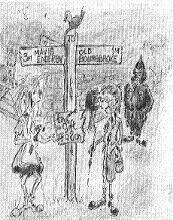
There's no point in looking up there, Rowan. No-one's at home.

13 October 2007

Anniversary Blog


I'm the kind of man who tends to miss anniversaries. Well, they're all a bit silly really, aren't they?

So it's no surprise that I missed the anniversary of my own blog, where I first posted last year on the 12th October with some thoughts on the odd things which trigger memories. So why not do something similar today and begin with 'fairy clocks'?

I'm finding it, by the way, more difficult to post blogs regularly. When I started the idea was to ramble on about anything and everything, rather in the way I like to have long, discursive conversations in the pub. I seem to have become more self-conscious and desirous of producing something 'polished' whenever I write. Maybe, this is the time to make a new year's resolution and re-find the joy of talking nonsense.

So, fairy clocks. In other words, the dandelion in its seeding stage, those pretty balls of spores that children used to blow in order to tell the time, the number of puffs required to denude the stalk being the hour of the day. I wonder if they still do that.

I left the house to catch a bus the other day and was surprised to see the lawn carpeted with them. They seemed to have sprung up over night. It triggered memories of spending summer days wandering around fields and woods many years ago. In those days, during the summer holidays, children would leave the house after breakfast and return for tea, their parents quite unconcerned about danger, human, animal or physical.

We would swim unsupervised in the 'forty-foot' drain, make arrows from garden canes and nails, throw stones into wasps nests, light fires, practice riding bikes around corners without touching the handle-bars, and slash with sticks at vegetation.

By that time we'd gone beyond blowing the spores off fairy clocks. We preferred to do our part in the symbiotic relationship with them by kicking the hell out of them. No matter. The seed was spread far and wide, as the dandelions wanted. (Forgive the teleology). just as birds eat berries and pass the seeds through their gut, and bees spread pollen in return for nectar, we were doing our bit for dandelions in return for fun and fresh air.

The earlier game of blowing at them to tell the time had given us another benefit, namely a healthy lesson in scepticism. When three little boys get three different times from the exercise, they tend to doubt the foolish adults who had told them such nonsense.

Why do parents tell their children all these lies? Jack Frost painting the windows in winter; fairies (again) leaving coins under the pillow in exchange for teeth, or constructing perfect rings of mushrooms within which to cavort.

To be honest, those are all beautiful conceits, but why aren't children told that they are metaphors? Yes, I know that people say that 'children must be allowed their childhood', and the years of childhood are indeed the years of wonder. But isn't it just as wonderful to know the truth about these miracles of nature. I still don't know how the phenomenon of mushroom rings occurs.

The essential, defining characteristic of the human animal is his mind. But more than that, we have evolved in such a way that we have perhaps the longest period of immaturity in the animal kingdom, something like 16% of our lives. All that time to grow and learn, learn, learn.

And yet how often do you hear parents impatiently discouraging their children's questions or palming them off with cliches and ex cathedra judgments.

You can tell a lot about a person by discovering when he stopped believing in Father Christmas. It could be useful at a university selection board. Imagine:

Interviewer: When did you stop believing in Father Christmas?

Candidate: But I haven't. I still believe in Father Christmas.

Interviewer: I'm sorry, but a degree in maths, physics, biology or philosophy is out of the question in your case. I think you should read theology.

Yes, that's what I'm getting round to. Religion. Stuffing children's heads full of superstitious mythology is one of the worst kinds of child abuse. We rightly make a hell of a fuss about debauching their bodies, but let's show their minds a bit of respect too.

I'm not talking about children being told that Jesus is weeping because they've been caught stealing a Mars bar; or terrified by visions of hell because a mother thinks her son's socks are suspiciously stiff.

Nor am I condemning religion because some rogue priests allow the frustrations of their life-denying celibacy to spill over into confirmation candidates. Or because others use it as an excuse for murder or the persecution of teachers who give teddy bears a funny name and tell kids the story of the three little pigs

Funny where the thought process leads you.


27 July 2007

'The God Delusion' by Richard Dawkins


[1]

Just after finishing Richard Dawkins’ The God Delusion, I happened to watch Elmer Gantry again.

It’s Burt Lancaster’s film, and he plays the role he was born for, but I’ll forbear lyricising about Burt and mention just one scene. This is where Arthur Kennedy, playing once again his cynical, sceptical but decent reporter character, has written an article condemning the hysteria and charlatanism endemic in ‘revivalism’.

In order to get the newspaper to print a retraction and make space available for a rebuttal, Elmer Gantry cross-examines the journalist about his religious beliefs. Kennedy’s character wheedles and prevaricates. He talks about the Bible being ‘beautiful poetry’; he admits how much he would like to believe. To confess to atheism, at that time, in America, was almost unthinkable.

And even today, we are browbeaten into showing respect for religion. On a radio show recently I heard Robert Winston, who professes Judaism, criticising Dawkins for his insulting use of the word ‘delusion’ in the title of this book. As I listened to him, I thought of the line, ‘Tread softly for you tread on my dreams.’

How could this intelligent man, I thought, not just believe, effectively, that there are fairies at the bottom of his garden, but expect other intelligent people to respect that belief? That delusion. That dangerous, dehumanising delusion.

Why is it that we are so careful in this country to understand and placate Muslims? Is it just that we afraid of being murdered? Maybe. But then why are we so concerned with a possibly diseased
bullock, considered ‘sacred’ by a bunch of Hindus, who howl with outrage at the sacrilege committed by officials entering a ‘holy shrine’ to cart the damned thing off for slaughter. The man in charge actually took his boots off before entering. Can you believe it?

Can you believe that the case actually got to the Court of Appeal? I doubt if my cat would get the same consideration.

[2]

Dawkins gets the respect thing out of the way early and moves on to ask what people mean when they talk about belief in ‘God’. It’s what I always ask when someone asks me whether I believe in God. Which God? Allah, Jehovah, Pan, Thor? Aphrodite? Maybe I’d get down on my knees for her.

What sort of ‘god’? The clockmaker, the personal interventionist, the omnipresent immanence?

He checks off all the so-called proofs of some sort of god’s existence and easily shows how spurious they all are, before attempting to make some sort of case for the non-existence of God. Proving a negative is not easy at the best of times. So why bother trying, especially when not only is there no evidence for the positive, but we don’t know the nature of that ‘positive’, and it’s of no practical relevance to us anyway?

The answer to that is that the power of theism and its attendant religion is at best a dilution of our greatest talent, namely our reason; and at worst it is a seedbed for fanaticism, obscurantism and murder.

[3]

Dawkins seems to share this view, because not content with making an intellectual case for rejecting theism and embracing atheism, he goes onto the offensive. And he’s quite right to do so. Theists and religionists have had it their own way far too long, with their demands for respect, their indoctrination of children and their all-round bullying.

It’s timely too, when you can’t open a newspaper without seeing the stranglehold of militant Protestants on US politics, murderously militant Islam and the pernicious influence of Catholicism in the Third World.

Dawkins tries to explain the existence of religion in evolutionary terms, as a by-product of some useful mutation, primarily the tendency of children to believe their parents, to whom they are attached for a substantial part of their life. Add to that our inclination to form groups and avoid isolation, and the necessity for some emotional basis for pair-bonding, and it’s not fanciful to see by-products in nationalism, tribalism, religious affiliation (and fanatical support for football teams).

Religion gives us answers, something the human animal yearns for. And it gives us power. Every parent likes to invoke an authority figure to reinforce their own attempts at discipline. For example, ‘Wait till your father gets home,’ or ‘Don’t let that policeman see you.’ God is the best bogeyman you think of.

An issue Dawkins doesn’t address is whether humans have come to a point where evolution is not working any longer, because we are able to interfere with it. Our social morality forbids us, for example, to let the weak die; it also prevents males from distributing their seed as widely as they are programmed to do. At least it tries to.

Moreover, we shouldn’t forget that evolution is a hit-and-miss operation. For every useful mutation or trait-elimination there must be millions of useless or threatening ones. Such as religiosity.

[4]

While Dawkins’ polemic against religion is timely and necessary, he is less than politic in singling out certain moral issues with which to attack it. Abortion, for example. An attack on religion because it often forbids abortion is unlikely to be effective with people like myself who are uneasy about the wholesale termination of pregnancies. My concern has nothing to do with religion. I could argue that we are not giving evolution a chance, when healthy intelligent parents destroy their own genes.

Religion’s frequent prejudice against homosexuality is another of Dawkins’ bĂȘtes noires. While tolerant myself I can easily understand a dislike of the practice in purely non-religious terms. After all, are not homosexuals, like nuns and monks, an evolutionary dead-end?

[5]

I have to say that I found a lot of Dawkins’ scientific explanations difficult to follow. But his final chapter, where he tries to describe the wonder of a mysterious world and the joy of forever discovering more about it without benefit of easy ‘revealed’ explanations, is inspirational.

His book is dedicated to Douglas Adams, with this quotation:

Isn’t it enough to see that a garden is beautiful without having to believe that there are fairies at the bottom of it too?

01 November 2006

Faith, crap and clarity


I listened to John Humphreys interviewing the Archbishop of Canterbury yesterday. The basis of the programme, which was one of three, the other two being with leaders of the Jewish and Muslim 'faiths' in Britain, is that Humphreys asks them to overcome his scepticism about the existence of God.

As expected, it was a waste of time.

What is it about this word 'faith'? If you honour any idea, however outlandish, with the label 'faith', it is treated with respect. Why? If Humphreys were interviewing the Prime Minister, he would be quite happy to call him, effectively, a crook, a liar, a cheat, dishonourable, self-serving, self-deluding, etc . . .etc. But he treated the Archbishop as a wise man, who appeared to possess some secret mystery, that he, Humphreys, just couldn't grasp. Rather like me talking to Albert Einstein about relativity.

First question: 'You cannot say for certain, can you, that you know that God exists.'

Reply (more or less): 'I believe in the reality of God.'

Don't you call that begging the question?

And neither man defined what he meant by 'God'. Zeus? Odin? An inner light or some transcendent personal being? Voltaire's clockmaker or an unknowable immanent universal force? Even so-called Christians can't agree. There is a world of difference between the God of the evangelicals and the Catholics and the one preached (oh so politely) by liberal theologians. And what's all this about Jesus being the Son of God?

The trouble with the Archbishop is that he's not an evangelical. They do know. They have a personal relatonship with him, talk to him, have prayers answered, know about miracles. They say. Of course, sometimes the answer to a prayer is no, and more often than not the miracle doesn't happen. They still don't know, in the way I know they're is a computer in front of me at this moment. (Don't tell that it's a figment of my imagination and that nothing exists outside my own consciousness. You may be right.)

If something demands faith before it can be believed, then you have to be pretty desperate to believe in it. No-one, for example, can prove there are no unicorns in the world. So why do I feel no need to live as if there are unicorns? All it takes is faith. With God, it's partly cultural, but I think it's fear, primarily. If there is no God, of any sort, there are no easy answers to the beginning and end of the universe or of our own lives. We have no meaning. We have no fundamental moral rules to live by. We are all alone in a cold, alien universe, random specks of life, as meaningless as a brief spark from a fire.

Does God intervene in the world, they discussed. Does it conflict with free will? And so on to the old chestnut about a loving God allowing wars, disease, genocide, and so on. It was taken as read that God is loving. It was taken for granted that man has free will, forgetting that many Christians do not actually believe it. 'By their fruits shall ye know them' it says somewhere in the Bible. Original sin makes all human actions sinful, according to Calvinists and others who believe in the sovereignty of God. Of course, they have contradictons of their own to contend with.

The Archbishop steers clear of such fanaticism, preferring to accentuate the 'niceness' of Christianity, to which he would never try to convert anyone. 'Faith is a gift,' he says, forgetting for a moment that God does not intervene. No, I forget, we can use our free will to reject that gift.

So, let me get this clear. I have the choice to accept a gift called 'faith', which is a decision to believe something which is not defined and for which they're is no proof and which may be in total contradiction to the belief of somebody else, who has also accepted this gift.

Beware of Archbishops bearing gifts.

(The cartoon, by the way, was found on The Cartoon Blog)


Oxymoron of the day: A theological scholar